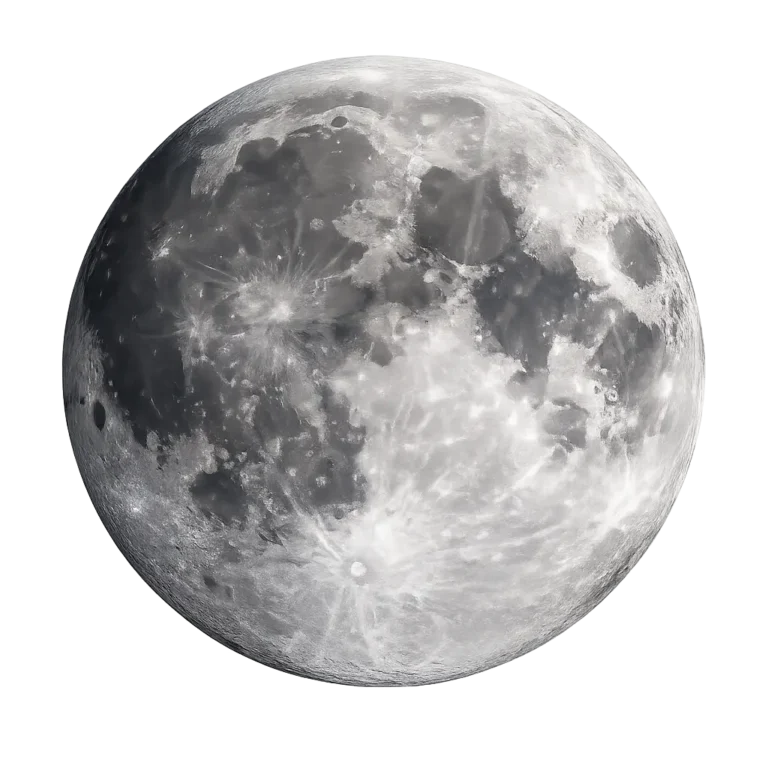
Moon - The Reflective Queen of the Soul
In Vedic Astrological systems, the Moon (Chandra/Soma) is highly revered. The Sun signifies the soul and our outward identity; however, the Moon describes the Manas (the emotional, mental mind) and signifies our perspective of ourselves and the world around us.
In many ways, the Moon could be even more influential than the Sun in shaping individuals’ eventual outcomes, as it expresses inner peace of mind, happiness, and social functioning, which are essential to our emotional development.
Within the zodiac signs, no other celestial body moves through its orbit more rapidly (2.25 days through a zodiac sign), mirroring our ever-changing emotional states.
The Moon relies on the Sun’s light to shine; the Moon does not produce its own illumination. This truth conveys spiritual meaning through astrological teachings, suggesting that the mind is a reflective surface. When the mind is tranquil, much like a calm reflective surface (i.e., a lake), it accurately reflects the light of the Sun (soul/manas).
Conversely, when an individual’s mind is stressed or agitated, their perception of the light from the Sun is cloudy. Thus, the Moon represents one’s mind and is representative of the individual’s internal harmony and psychological health.
Basic Identity/Essence
In order to learn more about the Moon’s cosmic energy, we must understand the Moon’s core essence. The core essence defines the basis of the way the Moon’s energy operates within our life and, therefore, defines the Moon as possessing “Planetary DNA.”
Attribute | Detail |
Sanskrit Name | Chandra / Soma |
Gender | Feminine |
Element (Tattva) | Water |
Guna | Sattva |
Ruling Zodiac | Cancer (Karka) |
Exaltation Point | Taurus 3 Degree |
Debilitation Point | Scorpio 3 Degree |
The Moon is a feminine energy and represents a nurturing, receptive, compassionate quality of mankind. Furthermore, the Moon is associated with the Water element, which is the element that governs all liquids in the body (blood, phosphorous, electrolytes, etc.) as well as the tides of the oceans.
The Moon is classified as a Sattvic planet and strives toward purity, peace, and clarity.
The Moon is exalted in strength in Taurus (earthy, stable, strong) and in debility (weakness) in Scorpio (water, deep, turbulent emotion).
Moon’s Significations (Karakatwas)
The karakatwa of Moon indicates all of the deepest, most personal issues, including childhood issues, and the present condition of mental health. They are associated with the Moon.
The Primary Meaning of the Moon Is: Mind and Emotion.
The Moon represents the mind -but not in its logical/analytical sense, as does Mercury – but in its instinctive/emotional sense. The Moon is the source of your gut feeling, your intuition, habitual reactions to situations that arise in your life; for example, your natal Moon will create feelings of love when you experience something you love, or feelings of sadness at times when you feel sad for absolutely no reason.
The Physical Body: Fluids + Vital Energy.
The Moon rules the lungs, blood, and chest area. The Moon is associated with the element of water; therefore, it represents the balancing of fluids within the body, including the lymphatic system.
For women, especially, the Moon is the most important planet for health due to its ruling of the menstrual cycle and fertility. The Moon connects biological rhythms with the cycles of the Moon; thus, a well-balanced Moon will often display itself in the form of a healthy-looking complexion, bright and active glares, as well as a high level of vitality within you.
Relationships: Mother + Nourisher
From a societal perspective, the Moon serves as the universal symbol for “mother”, which signifies numerous ways in which a mother provides nourishment, protection, and unconditional love during the first two years of life.
As such, the position of the Moon within a birth chart provides much insight into the relationship one has had with their mother, as well as one’s ability to care for/not take care of others. The Moon representation also identifies the home environment and sense of belonging within the family/community.
Professional Careers: Caregiving/Public Service
The Moon is the “public” and the “nourisher”; therefore, careers associated with taking care of others fall under the Moon’s rulership. Such careers would include nursing, psychology, social work, and the hospitality industry.
Due to the connection the Moon has with liquids, the dairy industry, marine life, or water management would also fall under its vibration. The connection that the Moon has to large masses of people creates a connection; therefore, people with successful Moons have the potential of becoming successful politicians or public leaders due to their “magnetic” attraction to large numbers of people.
Astronomical and Mythological Context
The myth of the Moon is a beautiful love story that teaches us how to learn by experiencing ups and downs in life.
The Moon’s story as the 27 wives takes place through the 27 Nakshatras as per the Puranas’ Story of Chandra (the Moon / God of the Moon).
Chandra was a beautiful and bright (radiant) looking Deity and married the 27 daughters of King Daksha. These 27 daughters are the same as the 27 Nakshatras (Lunar Mansions) through which the Moon travels every month. Chandra was deeply in love with his one wife, Rohini, but neglected the other wives.
Chandra’s favouritism caused King Daksha (father-in-law to Chandra) to curse Chandra to wither away and lose his brightness. Chandra sought help from Lord Shiva, who changed the curse (modification) to waxing and waning cycles for the Moon. This story explains the waxing and waning of the Moon and is an excellent example of the importance of maintaining balance and fairness in our emotional lives.
Vimshottari Dasha: The Decade of Motion
In the Vimshottari Dasha system, the Moon receives a 10-year term. During a Moon Mahadasha, one tends to focus on themselves and their internal world, their home, and their sense of emotional security or stability. The time frame represents a lot of change for an individual in relation to their living arrangements or family structure. If the Moon is strong in the chart, this period will yield great mental or emotional calm, success, and recognition within society.
Relationship with other planets
The Moon is unique in its relationship to the other planets because it is the most responsive and sensitive Planet of the Grahas.
Friends: Sun and Mercury. The Sun gives the Moon (Chandra) its Light to reflect, and Mercury gives Chandra the intellectual foundation on which to understand its emotions.
Enemies: The most interesting fact about the Moon is that it does not consider any of the other planets to be enemies; its very nature is to be all-inclusive. However, when the Moon and Rahu or Ketu align, the Moon experiences distress.
Neutral: Mars, Jupiter, Venus, and Saturn can be considered neutral from their relationship to the Moon, but it will depend on their Position.
Analysis of Behaviour
The position of the Moon in your natal chart will make up your default emotional settings, whether you feel anxious most of the time or if calmness is your default setting.
”Dignified Moon” (the “Strong Mind”)
When the Moon is “strong”: particularly being Full Moon (Purnima) or positioned in the Moon’s own sign of Cancer or its exaltation sign of Taurus, we have a person who has great mental stability and intuition. The person will prove to be naturally empathetic and will be considered to have a ‘healing’ avocation.
As an excellent listener, this person generally will not have much difficulty rebounding from emotions, and typically will enjoy a very peaceful, happy domestic life. The person possessing a strong Moon will also be able to remain calm during chaotic events around them.
“Afflicted Moon” (the “Restless Heart”)
An afflicted Moon (i.e., a weak Moon, such as when it is within close proximity of the Sun or when it is in its debilitation, or if it is the Moon in Scorpio) can also cause an individual to be emotionally “restless” (i.e., full of angst). An individual possessing an afflicted Moon may suffer from mood swings, anxiety and/or feelings of insecurity.
The individual may be unable to concentrate and is generally very sensitive to how others perceive them. Physical manifestations of an afflicted Moon include: respiratory problems, fatigue and low energy. An individual with an afflicted Moon often feels “homeless” emotionally; even when they have an actual residence they can occupy.
Remedies and Rituals
Vedic astrology offers remedies to help balance out the Moon’s energies, as it is closely related to our mental peace through the use of various charged crystals.
Crystals: The primary crystal associated with the Moon is the pearl. When placed in silver and worn on the little finger of the right hand, pearls help to calm the mind and reduce outbursts of emotion.
Mantras: The sound waves of mantras have proven to be very effective for the Moon.
Seed Mantra: Om Shram Shreem Shroum Sah Chandraya Namah.
Gayatri Mantra: Om Padmadwajaya Vidmahe Hema Roopaya Dheemahi, Tanno Chandrah Prachodayat.
As Mondays are considered the day of the Moon and a day to fast in honour of Shiva, who has the Moon in his hair, fasting, or doing a puja for Shiva, on Monday, is a great way to increase mental clarity.
Charity: Giving to others on Monday evenings by donating white (milk, rice, white clothing, and silver) to help relieve the Moon.
Lifestyle changes: Pranayama (breathing exercises) and meditation are the best forms of remedy for the Moon.
Drinking water out of a silver cup is also said to help calm the Moon; however, spending time with your mother or nurturing women to help heal the Moon is the most effective.
In addition, being near large bodies of water (ocean/lake) helps with emotional instability and resets an unsettled mind.
The Moon is a constant reminder that all of its cycles are temporary, just as are our low emotions. Understanding your Moon will enable you to master the skill of regulating your emotions, which ultimately leads to true inner peace.
Frequently Asked Questions (FAQs)
In astrology, the Moon, or Chandra, represents our subconscious mind, emotional state, and other internal thought patterns. The Moon represents the divine “mother” and is related to our instinct to nurture, our sense of safety and security, and how we respond to life events. Therefore, the Moon represents our inner selves and our desires, moods, and memories, similar to how the Sun (in astrology) represents our outer identity and soul.
The Moon represents the earthly, watery, and fluid nature of our minds, signifying how we see the world and our ability to find peace and happiness in our experiences.
The best Moon sign for good luck is Taurus, which is the exalted sign. Here, the Moon can experience stability because it is not subject to fluctuations; it provides the native person with emotional stability, financial success, and, overall, a peaceful home life.
Another very beneficial Moon sign is Cancer, the Moon’s own sign, so the person has strong family ties and keen intuition. The Moon is also very favourably placed in Kendra houses (1, 4, 7, or 10) and aspected by Jupiter (forming Gaj Kesari), which results in a lot of good luck for the individual in fame and prosperity.
In Hindu mythology, Chandra (the Moon) had 27 wives (the nakshatras or lunar constellations), but Rohini was his only love. Due to his overwhelming affection for Rohini, the other wives complained to their father, Daksha. This preference is a symbol of the Moon exalted in the Rohini Nakshatra located in Taurus, where Moon energy is most stable, creative, and nurtured. Therefore, it serves as a good example of why energy from the Moon changes as it crosses through the different signs.
The most important role of the Moon in astrology is to be the filter through which you experience all of the planets’ benefits. No matter how much wealth or success other planets might provide for you, if your Moon is weak, you cannot enjoy what these planets have given to you. The Moon is the “Jiva” or living force of the mind.
Moon also signifies Mother, fertility, childhood and the general population. Because the Moon moves the fastest, it indicates the daily ‘weather’ in our lives and affects our immediate reactions, social exchanges, and overall mental health.
In a natal horoscope, the Moon represents the mother, the mind, and your home life. The Moon indicates your emotional needs and which activities provide you with security. Moon signifies “liquid cash”, nourishment, and is the left eye.
The house where Moon resides in your birth chart indicates where you will be most emotionally connected. Moon also signifies the General Population (public) and/or how popular you are. For men, the Moon will indicate the qualities of women you attract to you or your nurturing side.
Moon weak will usually manifest itself as extreme and frequent fluctuations in mood, anxiety, and lack of mental stability. You may feel “restless”, have developed a “victim” mentality, and physically you could experience very frequent colds, flu-like symptoms, or problems in your lungs or issues concerning your breasts or stomach. The person whose Moon is weak also has difficulty developing any deep emotional attachments and/or frequently feels unloved and neglected. Finally, the Moon has difficulty maintaining a routine and often overthinks or suffers from insomnia.
A weak Moon may create emotional upheaval, causing you to experience your life unpredictably; Chitta Vritti refers to emotional disturbances resulting from weak Moons. Decisions are often clouded by Chitta Vritti and a weakened affinity with one’s mother, which may also be associated with health problems. Careers can be negatively affected, as one may be unable to keep one’s mind focused, or, in public, feel unable to withstand external pressures. Having no “sukh” or peace of mind makes triumphs feel insignificant and unfulfilling.
The best ways to enhance and strengthen a weak or malevolent Moon are to show compassion and service to the female figure in your life. Drink from a silver glass; wear light clothing on Monday. Donating milk, rice, or white sweets on Monday nights can also help.
Practising breathing exercises (pranayama) near a water source or by viewing any body of water will help stabilise the mind. On a spiritual level, devote time to Lord Shiva, whose forehead features the Moon; this is a powerful way to enhance and balance your lunar energy.
The Moon has a different influence when found in each of the twelve houses in your natal chart. The first house represents emotion, and therefore, the Moon will give you a charming yet sensitive personality; the fourth presents the Moon with a temporary space for comfort, both at home and in emotional security. In the tenth, the Moon grants you fame through your profession and public acclaim.
The 6th, 8th, or 12th house known as “Dusthana,” will have negative effects such as poor health (mental trauma), a lot of traveling expense, etc., related to emotional “fuel” expenditure based upon how you will use your emotional “fuel” for things that are important to you; such as family, career, and/or spirituality.
While the Lagna describes your physical body, the way that you appear in the world, and how other people perceive you (your “mask”), the Moon sign (or Rashi) describes the “emotional” component of your soul based on how you feel/who you are when no one is around you. The Lagna serves as the structure for your life events, while the Moon sign will provide you with your feelings toward your life’s events. In Vedic Astrology, your Moon sign serves as the primary starting point for verifying predictions.
Vedic Astrology is structured around a “lunar” principal system of astrology, which means that all aspects of the “Vimshottari Dasha” system are calculated from the Moon’s position in your birth chart. Additionally, the Moon’s position will serve as the basis for determining both the “Nakshatra” and “Gochar”. The Moon position also serves as the basis for the “Janma Kundli”. Since the mind produces our actions and the Moon produces our minds, Vedic astrologers used the Moon sign as a foundation for understanding a person’s destiny, characteristics, and mental abilities.
The Moon is highly sensitive to the influence of all other planets in the solar system. For instance, if the Moon is in the company of Jupiter, it can produce Gaj Kesari Yoga, which produces optimism and wise Thinking. If the Moon is in the company of Saturn, it can produce Vish Yoga, which may bring sadness, discipline, and/or delays.
When the Moon is near Mars, it creates Chandra-Mangal Yoga, which can make a person with great energy and financial “driving” ability, but also one with a “hot” temper. If the Moon is without the completion of either side of two other planets, it produces Kemadruma Yoga, which may cause a person to feel isolated or alone, even with a successful, high-standard-of-living in the world.
In Hindu mythology, the Moon is the beautiful god, Chandra. He travels in a chariot pulled by ten white horses. Chandra is also the son of Sage Atri and his wife Anasuya. In mythology, the Moon’s phases (the waxing and waning) are explained as a result of a curse from King Daksha; however, that curse was cancelled/mitigated by Lord Shiva, which also explains the cyclical nature of our own moods.
Also, the Moon has an association with “soma”, the heavenly nectar of immortality. Therefore, in the Vedic tradition, Chandra is represented as the “manas” or mind of Purusha, the cosmic being.
The April 2026 Pink Moon in Libra signifies that it is a time for blossoming and seeking balance on an emotional level. Spiritually, it will be a time for “re-aligning” your relationships; letting go of grudges; and moving from the inner reflections of winter to the outwardly active growth of spring. The Full Moon in Libra allows us to find balance between our individual needs and our social responsibilities, both of which are important for achieving peace and an appreciation of the beauty in our lives.
The Full Moon in Libra will shed “light” (or provide you with “clarity”) on the “give-and-take” mindset you have with partners. You will be encouraged to either settle unresolved conflicts with those with whom you’re in a partnership or to make a definite, firm commitment. For some people, however, this may lead to a “climax” or a point of change where long-held emotions are revealed. Since Venus rules Libra, this Full Moon also enhances romantic and social connections; however, it can intensify your heightened sensitivity to any experience of imbalance within your social spheres.
This New Moon of April 17, 2026, represents an emotional rebirth. Since New Moons represent a time to start planting seeds, that is, set intentions for the upcoming month, depending on your astrology sign, that can be the first step toward starting a new career, creating a new wellness plan, or shifting your mental paradigm. This is a time when, externally, there is limited incoming energy and maximised potential energy available internally. Therefore, use this occasion for self-reflection and planning rather than taking immediate action.
The Sun is in one sign for 12 months, which means it influences a large number of people for 30 days at the same degree. The Moon is in each sign for 2.5 days, so each sign is influenced by the Moon’s presence to a greater degree for a shorter amount of time; thus, its effect is more unique to the individual.
According to Vedic astrology, because our “perceptions” (Moon) create our “worldly experience,” if the mind feels happy, the individual’s life will reflect success. Therefore, the Moon’s location and the Nakshatra (which represents the constellation the Moon resides in) create a more comprehensive, detailed, and unique energetic blueprint of an individual’s emotional landscape, karmic timing, and cycles than the Sun sign alone can.
You need your actual birth date, time of birth and location of birth to determine your Moon sign. While a person has a Sun sign for 30 days, their Moon will change signs every 54 hours. An astrological calculator or almanac (Panchang) can be used to find out what sign the Moon is in when you took your first breath; therefore, this Moon sign will become your Janma Rashi, while the specific star that the Moon was present in at the time of your birth is called your “Janma Nakshatra,” and is equally significant for making predictions about your life.
A “strong” Moon acts as a protective layer on our minds, giving us resilience, clarity of emotions, and a positive perspective on life even in times of crisis, which is related to having been raised in a healthy and nurturing home and having a clear mind, as well as the positive aspects that come from the 11th house of the zodiac.
In contrast, when a Moon is weak, it has the propensity to leave the individual emotionally open to various issues, including the potential for clinical depression, anxiety, and possible bipolar tendencies, due to an unstable “mental base.” Where a strong Moon will provide the individual with a feeling of “contentment,” a weak Moon will create an individual who feels as if he/she will always be searching for peace, which can only be provided through certain remedies.
Yes, in Vedic astrology, the Moon represents the “Matru Karaka,” or mother. The Moon’s sign and house placement, along with any aspects to it from the other planets, tell the story of your mother’s life as well as how you relate to her. A well-placed Moon can indicate that your mother has/has had good health and a long life.
Conversely, if your mother has had/has been afflicted by Rahu or Saturn, you may see her as having struggled with various health issues or as having had an emotionally distant relationship. The Moon should always be assessed along with the 4th house and its lord to gain an accurate picture of your relationship with your mother.
The Full Moon (Purnima) is at its greatest gravitational pull and experiences its highest lunar energy. The Moon, which causes the Earth to experience high tides, also causes humans (mostly composed of water) to experience “emotional tides.” An increase of energy may enhance the senses and bring previously buried emotions to the surface.
Individuals already experiencing anxiety may be more prone to such feelings during emotionally charged times like the full Moon. The “added” emotional pressure may cause restlessness, sleep disorders, or sudden, vivid dreams, since the full Moon period is generally known as a time of abundance (both positive and negative).
Yes, the primary astrological factor contributing to identified anxiety issues is an afflicted or weak Moon in an astrological chart. When the Moon is combined with Rahu (creating Grahan Yoga) or with Saturn (forming Vish Yoga), the person’s mental capacity becomes shadowed, leading to irrational worry and/or an excessive number of “what-if” scenarios, as well as recurring negative thought patterns.
Since the Moon governs the manas (the perceptive mind) portion of the brain, any negative disturbance to the Moon will create a corresponding negative distortion in how a person perceives and processes information, leading to a perception of reality that contains non-existent problems.
Kemadruma yoga is the astrological configuration in which there are no other planets in either the second house or the twelfth house from the Moon, and there are also no planets located in the four “Kendras” or quadrants from the Ascendant. This yoga is widely known for producing an internal sense of separation.
An individual may have family, wealth, and many friends; however, they will still frequently feel alone within their own mind. This could also lead to financial difficulties. However, this yoga produces many independent thinkers and many spiritual seekers are identified as having Kemadruma in their chart.
In addition to performing healing rituals, it is possible to emotionally balance by following the lunar rhythm, being in proximity to water, meditating on a full Moon, or keeping a “mood journal” that matches your mood and how it changes through each of the Moon’s phases. You may also practice improving your emotional well-being through Trataka (candle gazing) and/or Chandra Namaskar (Moon salutation) yoga.
The most effective method for creating emotional balance regarding lunar manifestations is by learning to simply “observe” the feelings you are experiencing rather than becoming consumed by them. By doing so, you may remain calm regardless of the various phases of life that you are experiencing.
The Moon sign relates to “career fulfilment,” while your 10th house shows what you will do for work. For example, if you have Moon in a Water sign like Pisces, you could be happy working in an artistic/creative field or someone in a healing capacity. If you have Moon in an Earth sign like Virgo, you may be best suited to detail-oriented, service, or medical professions. When your Moon sign correlates with your profession, you will not only feel fulfilled in your profession, but you will also feel less stress. You will have a greater opportunity for a long-term career because you will have emotional stability at work.
The New Moon (Amavasya) is typically avoided as an auspicious day to start major projects (i.e., wedding, housewarming), due to low energy (lunar) at that time. It is, however, great for “planning” and “internal work”, and starting a project should be postponed until at least the 2nd or 3rd day of “Shukla Paksha” when the Moon has increased in visual brightness and strength, creating the necessary energy for growth in your project.
In astrology, the Moon is the ruler of all things “liquid,” which includes cash flow.
The Moon represents your “daily flow” of money and how much you have to spend based on “purchasing power.” Therefore, just as the tides come and go on the Earth because of the Moon, its movement helps you understand how you receive and spend money every day. Therefore, if the Moon is strong, you can have enough “liquid”, or money available at any given time to satisfy your needs, and also that your financial transactions will be productive and rewarding.
Suggestions for making a weak Moon (Chandra) strong: Part of the remedy for a weak Moon is focusing on “Self-care” and “Service”. Helping people in hospitals or nursing homes is a good way to strengthen your Moon. Carry a silver coin in your wallet, or have a silver pot with water in the North-East portion of your house at all times.
Avoid “staying awake late at night” due to excessive thinking, and get as much rest as possible by having a consistent sleep/wake schedule. The best way spiritually to “calm a disturbed Moon” is to chant the “Shiva Panchakshari Mantra” (Namah Shivaya).
Because silver is the metal for the Moon, it is considered to have “cooling” properties. Also, silver has a natural ability to “purify” itself and any liquid that comes into contact with it. Drinking water in a silver glass has a positive effect of “calming” the nervous system, and also of reducing the “heat” of anger or anxiety.
It is believed to “balance” both the “Kapha” and “Vata” characteristics within us. By making it a regular habit of drinking from a silver glass, you can provide yourself with a permanent and continual remedy for a weak Moon, and thus strengthen the lunar vibrational energy in your physical and emotional bodies.
The best Beeja Mantra that is used for the Moon is “Om Shraam Shreem Shroum Sah Chandraya Namah.” Chanting this mantra 108 times on Monday evenings (especially while looking at the Moon) brings tremendous clarity of thought. If you just want a simple daily mantra, you can spell it as either “Om Chandraya Namah” or “Om Som Somaya Namah”.
Any of these mantras resonates with the “Water element” in your body, helping to “still” the mental waves in your mind, and providing an overall feeling of peace.
Since the Moon is in a debilitating position in Scorpio, most astrologers agree that while it may help strengthen the Moon, it may also amplify the negative and intense emotions associated with a Scorpio Moon.
The Moon will only benefit from a Pearl when it is in a position to cancel out the debilitation (i.e., “Neecha Bhanga”) or if it is in a beneficial position for one’s specific Lagna (ascendant). It is important to consult an expert about whether your mental state requires cooling or strengthening before considering wearing a Pearl.
Hindu astrology represents the Moon (Chandra) as represented by a male deity (a handsome king); however, the Moon’s energy (Prakriti) is considered feminine, nurturing, receptive, and emotional. While the lunar deity is a male representation, the energy associated with the Moon is classified as female; thus, the Moon’s association with motherhood, fertility, and the Yin energy of the universe, as well as the soft, reflective light produced by the Moon, are complementary to the hot, direct light produced by the Sun.
The Moon represents many organs, but primarily rules the mind (Manas), face, and body fluids (blood, plasma, lymph, saliva). The Moon also rules specific organs – the chest, lungs, and stomach.
In women, the Moon plays an important role in the menstrual cycle and the breasts. Since the Moon rules the left eye (and the right eye for females in some traditions), a negative lunar aspect can hurt these areas of the female body, resulting in liquid retention, digestive issues, or respiratory sensitivities.
Your Moon sign, or rashi, is the zodiac sign (rashi) in which the Moon is located at the exact moment of your birth. Because of the Moon’s speed of movement across the zodiac, the Moon sign is much more individualised than the Sun sign.
The Moon sign represents your emotional home, which describes the qualities of the inner self. So, whether you are a risk-taking Aries Moon or an extremely practical Taurus Moon, the Moon sign is the answer to how you feel and what you need to be happy.
Yes, the word “rashi” refers to the Moon’s zodiac sign in Vedic astrology; typically, when someone asks, “What is your rashi?” in India, they are asking for your Moon sign, not your Sun sign. The rashi is the foundation of Indian horoscopes. It determines many aspects of a person’s life, including the initials used in naming, compatibility in marriage, and the timing of major events through dashas.

Acharya Neeraj Dhankher
Acharya Neeraj Dhankher is a renowned Vedic astrologer and transformation coach, known for practical guidance on horoscopes, transits, remedies, and predictive astrology with 29 years experience.