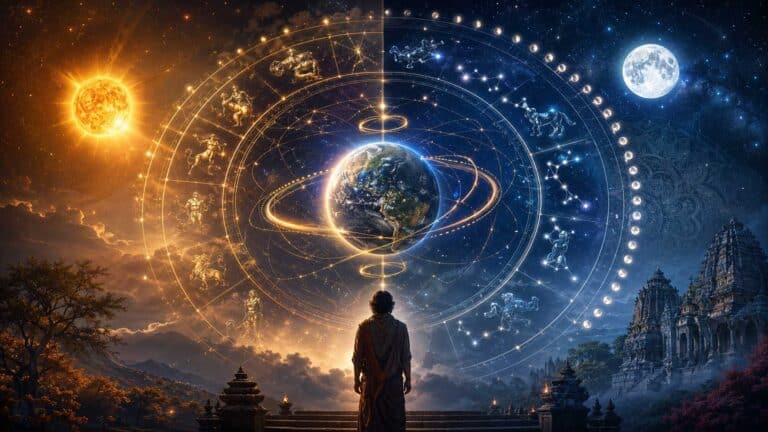
If you’ve ever read a horoscope and felt it doesn’t describe you or that the stars haven’t told the truth, you’re not crazy, and the stars are not wrong about their positions. The chance that your true identity aligns with the specific Zodiac sign associated with your birth date (or even a different sign) is actually quite high.
In astrology, there exists an enormous discrepancy between the two systems of astrology that have existed for thousands of years, and there is much debate as to which is correct. The two systems of astrology are not simply a dispute over dates but rather have very different ways of measuring the dimensions of the Universe.
After reading this article, you will understand the significance of being born in a different constellation than your Sun Sign; the degree to which it will affect you and the effect it will have on your Cosmic Identity.
The 24-Degree Gap: The Earth is Wobbling
The primary cause of your zodiac sign being “off” has to do with the Precession of the Equinoxes.
Think of Earth like a spinning top. Not only does it spin perfectly upright, but it also wobbles slightly. This wobbling is an exceedingly slow process. However, this “wobbleyness” causes Earth to shift its position towards the stars over hundreds of years.
- Western Astrology uses the Tropical Zodiac, which is tied to the seasons, and says that on the first day of Spring (Vernal Equinox), it is always 0 degrees Aries (whatever the actual position of the stars may be).
- Vedic Astrology uses the Sidereal Zodiac, which is tied to the actual or observable constellations, and accounts for that wobble (called Ayanamsa).
Currently, there exists approximately a 24° (degree) difference between the two systems.
Since the zodiac is 30° wide, that means that with a shift of 24°, almost 80% of the people will be placed into the preceding sign when referencing a Vedic chart.
Therefore, although you may feel like a fierce Aries, the Sun in your actual astrological zodiac would probably have appeared to be in the gentle, dreamy stars of Pisces when you were born.
Vedic vs Western Astrology: Personality vs Karma
When someone asks me which system is “better”, I don’t reply with an opinion and instead say, “It depends on what you want”. Clearly, both systems serve different purposes.
Western Astrology: The Study of the Personality
Western astrology is an excellent form of psychological mapping due to its connection to the seasons (the cycle of light and dark on the planet). This system has a strong emphasis on your ego, personality, and “how” you experience life.
In other words, this system describes your personality traits and how you interact with the world in the present. The character of this system is solar-based, as it emphasises the Sun as the centre of one’s identity.
Vedic Astrology: The Karmic Path to Destiny
In Vedic astrology, also known as Jyotish (which means “the science of light”), the model can be viewed as a karmic GPS. The model is fundamentally Lunar-based. The main premise of this system is to provide not only an understanding of who you are, but to give you an understanding of what is going to happen to you and why.
Using the actual location of celestial bodies in relation to your Natal Chart, Vedic astrology provides accurate predictions about the possible outcomes of your actions (karmic fruits).
For example, while Western astrology may indicate that you have a predisposition to be wealthy, Vedic astrology would predict the time at which this will occur.
The Three Pillars: Why Your Vedic Sign Feels Different
When approaching Astrology from a Vedic perspective, you must examine three things that will usually modify your personal view of yourself:
1. Rising Sign (Ascendant) – King of Your Personalised Mindset
Astrology based around the Western world uses the term “what’s your sign?” in reference to where the Sun is located. However, the most important element within Vedic astrology is your Rising Sign (Lagna), which represents the body, is constantly changing approximately every two hours, shows you the direction of your path in life and ultimately represents what we call your Vessel.
Therefore, if your Rising Sign moves from Leo to Cancer according to Vedic astrology, your focus in life will no longer be to seek out attention on a stage, but instead to want to keep your home safe.
2. The Moon is Your Mind
In the Vedic tradition of astrology, the Sun represents the soul, but the Moon represents the Mind. Where we live is through our emotions and thoughts; therefore, the Moon has a more telling view of your daily life than the Sun.
A total of 27 Lunar Mansions, called Nakshatras, can be used in Vedic astrology. They provide a wealth of data with a high level of accuracy for describing the details of all people’s lives; to provide this much data using 12 individual signs from Western culture is nearly impossible.
3. Mahadashas: Cycles of Time
What is shared among all Eastern practices is their “secret sauce.” Western astrology is based on where planets are, whereas in Vedic astrology, planets are based on your Natal Chart through 12 different periods known as Dasha cycles.
Each person has at least one planet through two periods; therefore, you will be in a Jupiter Dasha for 16 years and then a Saturn Dasha for 19 years.
Therefore, it’s easy to see why two people who are born under different astrological signs can have completely different lives; you can be in a cycle of growth, and the other person is in a cycle of structure.
A Tale of Two Zodiacs: Which One Are You?
To give you a clear, practical understanding of this shift, let’s examine how the archetypes will change depending on whether you use the Tropical (Western) or the Sidereal (Vedic) Calendar.
(Note: The dates below will not always correspond for Western / Vedic; they do move a little due to changes year after year.)
| Western Sign (Tropical) | Vedic Sign (Sidereal) | The Energy Transformation |
| Aries (Mar 21 – Apr 19) | Aries (Apr 14 – May 14) | From “The Pioneer” to “The Visionary/Dreamer” |
| Taurus (Apr 20 – May 20) | Taurus (May 15 – Jun 14) | From “The Preserver” to “The Initiator” |
| Gemini (May 21 – Jun 20) | Gemini (Jun 15 – Jul 16) | From “The Messenger” to “The Builder” |
| Cancer (Jun 21 – Jul 22) | Cancer (Jul 17 – Aug 16) | From “The Nurturer” to “The Communicator” |
| Leo (Jul 23 – Aug 22) | Leo (Aug 17 – Sep 16) | From “The King” to “The Guardian” |
| Virgo (Aug 23 – Sep 22) | Virgo (Sep 17 – Oct 17) | From “The Analyst” to “The Leader” |
| Libra (Sep 23 – Oct 22) | Libra (Oct 18 – Nov 15) | From “The Diplomat” to “The Perfectionist” |
| Scorpio (Oct 23 – Nov 21) | Scorpio (Nov 16 – Dec 15) | From “The Alchemist” to “The Harmonizer” |
| Sagittarius (Nov 22 – Dec 21) | Sagittarius (Dec 16 – Jan 14) | From “The Explorer” to “The Researcher/Strategist” |
| Capricorn (Dec 22 – Jan 19) | Capricorn (Jan 15 – Feb 12) | From “The Architect” to “The Philosopher” |
| Aquarius (Jan 20 – Feb 18) | Aquarius (Feb 13 – Mar 14) | From “The Humanitarian” to “The Disciplinarian” |
| Pisces (Feb 19 – Mar 20) | Pisces (Mar 15 – Apr 13) | From “The Mystic” to “The Innovator” |
If your birthday is October 1st, you belong to Libra (Scales) according to Western Astrology. Therefore, you may spend most of your life trying to achieve balance as suggested by the horoscope.
However, in Vedic astrology, the Sun was located in Virgo on this date; thus, you may have more of an analytical, critical, and health-focused disposition than what is suggested by the stereotypical social nature of Libras.
Why Does “Vedic vs Western Astrology” Matter?
You may think, “What does it matter that there are stars – it doesn’t mean anything”, but this is incorrect. Predictive accuracy requires precise astronomical positions. If you tried to navigate New York City using a map of London, you would get lost; likewise, if the planets do not occupy the signs of the Zodiac defined by the astrological system, the report on the future of your life will be inaccurate.
The Western astrological system can be an excellent tool for personal development, in that it unlocks each person’s “shadow”, illuminates their aspirations, and defines their potential. It is akin to a consultation for self-healing, with unlimited possibilities offered by the universe.
Vedic astrology is a strategy-building tool. This system of Astrology was created for you to know when to begin your business venture, get married, rest and relax. The positions of the planets are used to create ‘Yogas’ (special combinations of planetary relationships) that provide insight and support for each activity, including the likelihood of achieving a royal destiny or the potential for sudden financial hardship.
The Wisdom of the Nakshatras
To fully comprehend why your zodiac sign could potentially be deemed “incorrect,” we need to consider more than just astrology’s 12 signs. Vedic astrology takes the entire 360-degree wheel and further divides this into its 27 Nakshatras. A deity influences each Nakshatra and has a specific “Shakti” (or power).
For example, consider two different people who are “Vedic Scorpios”; one was born under the Nakshatra known as Anuradha (ruled by the deity of Friendship), while the other was born under the Nakshatra known as Jyeshtha (ruled by the King of Gods). The first individual may be a loyal and kind-hearted friend, but the second individual could be considered an extremely powerful leader (and potentially intimidating).
Western astrology simply categorises both of these examples into the same group (Scorpio). Vedic astrology treats these two examples entirely differently by separating them with astounding detail and accuracy. This is why your Vedic sign may resonate stronger with you than with your Western sign, especially if you’ve ever felt disconnected from it.
Practical Application: How to Use This Information
If you’ve only ever related to astrology through your Western zodiac sign(s), I recommend also creating a Vedic astrology chart. You don’t need to let go of your Western zodiac; think about it in this way:
- Use Western astrology to understand your internal aspects (such as how you think and feel) and psychological triggers, and
- Use Vedic astrology to depict or explain the physical universe and time (such as describing the cycles of health and career).
When you consider both types of astrology, they provide a 3-dimensional perspective of your life because each reflects a different aspect of who you are and the way you experience life (what type of being, the path you walk).
Final Thoughts
I have been reading charts for over 25 years; during this time, I have seen thousands of people experience a feeling of being “home” when they learn their Vedic sign. Understanding that your chart aligns with the actual sky above you gives you a sense of stability and grounding in your life.
The “Vedic vs Western Astrology” debate is not about who is right, but about how both approaches view planets from different perspectives. For example, Western Astrology takes into account the Earth and its relationship with the Sun (the seasons). In contrast, Vedic Astrology takes into account the Earth and its relationship with the Universe (the Stars).
Your Zodiac Sign is not “wrong,” it is simply an aspect of the totality of who you are; it is a puzzle piece of the whole beautiful puzzle. If you have ever felt that the Western “mask” was too tight or too loose, try looking towards the East! The Stars are waiting for you to see them in their true positions.
Frequently Asked Questions (FAQs): Clearing the Cosmic Confusion
If I’m a Leo in Western, am I always a Cancer in Vedic?
Not necessarily; usually, yes. About 80% of people move back one sign, so if you were born within 5-6 days of the end of a western sun sign period, then you may remain in that sign according to Vedic Astrology, though you will be at the very beginning (0-5 degrees) of it.
Which one is more accurate for predicting the future?
Most professional astrologers have found that the Vedic method, which includes the Dasha (time cycle) system and Nakshatras, tends to yield much more accurate predictions regarding concrete timing/life events.
Do I need to know my birth time for Vedic astrology?
Yes, you need a more precise birth time than Western astrology. The Vedic Lagna (rising sign) and Moon Nakshatra are changing rapidly. An accurate birth time will determine whether you have a clear or a blurry map.
Can I be a “Cusp” baby in Vedic astrology?
Cusp signs in Vedic astrology are known as Sandhi, and they weaken the planet because it is transitioning between two different energies; therefore, you do not have “best of both worlds”, but rather your planet is “readjusting its baggage”.
Why isn’t Vedic astrology more popular in the West?
Vedic astrology is much more complex than Western astrology! Western astrology is typically very easy to read. It fits right into your “sun sign” newspaper columns, whereas Vedic astrology requires extensive calculations and an understanding of Sanskrit and Indian philosophy. However, due to the increasing public interest in deeper, more meaningful readings, the popularity of Vedic is growing by leaps and bounds worldwide.