
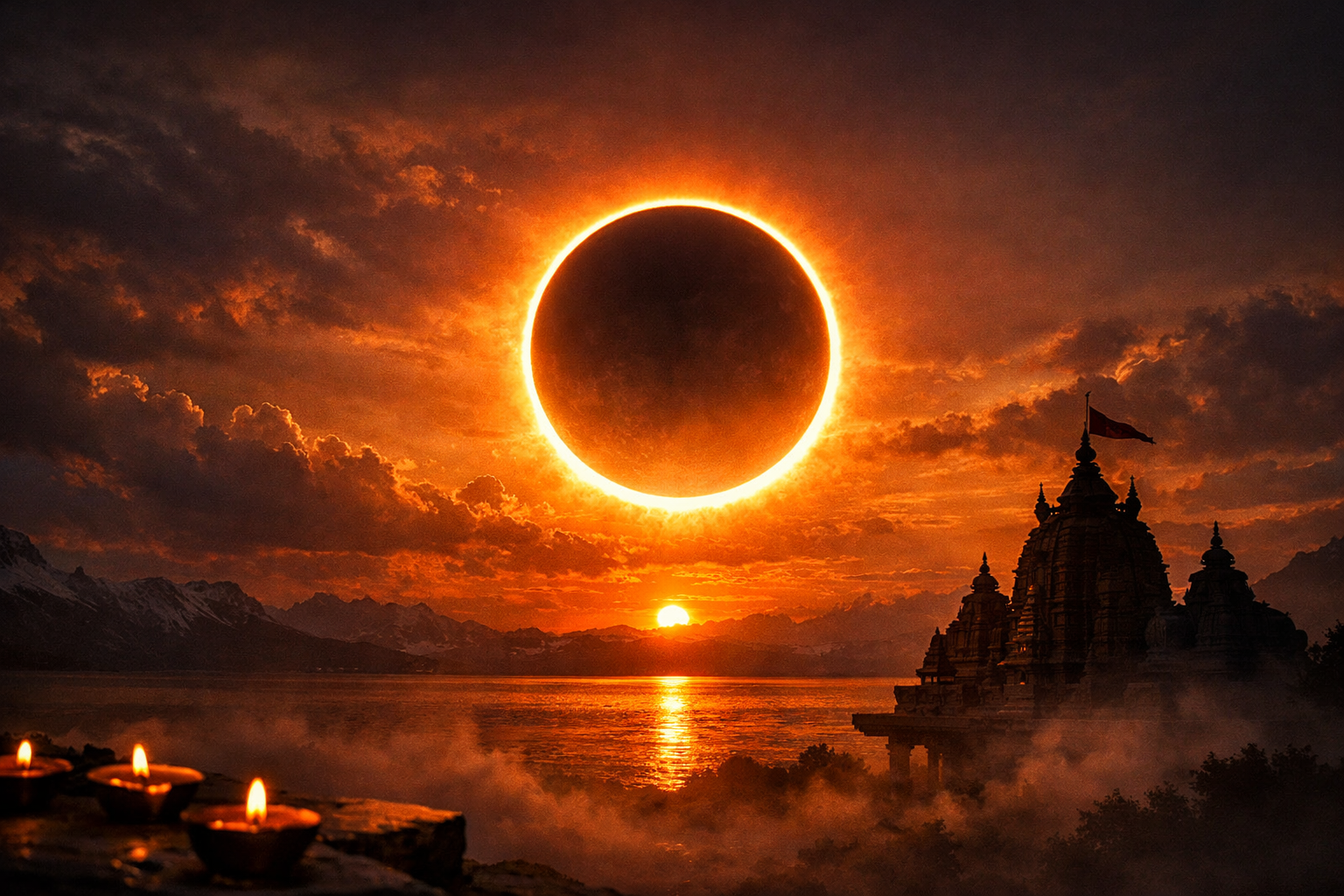
The solar eclipse (surya grahan) on February 17th, 2026 will be the first of the year, occurring between the Earth, Sun, and Moon. While the moon covers the sun again, reaching totality, it will produce an annular eclipse, also called a ‘ring of fire’, a striking physical phenomenon that symbolises the blending of modern science with Vedic tradition.
Date and Time of Surya Grahan
The annular solar eclipse will happen on February 17th, 2026, on a Tuesday.
While the eclipse is not visible in India because the path of the eclipse occurs in the Southern Hemisphere during the night or early evening in India, here are the calculated timings in IST:
-
Partial Eclipse Begins: 03:26 PM IST
-
Annular Eclipse (Maximum) Begins: 05:12 PM IST
-
Greatest Eclipse (Peak Phase): 05:43 PM IST
-
Annular Eclipse Ends: 06:12 PM IST
-
Partial Eclipse Ends: 07:58 PM IST
During an annular solar eclipse, the moon is positioned at its furthest from the Earth. Therefore, the moon appears smaller than the sun and does not fully block its rays, creating a bright outer ring around a very bright, fiery-like disc along the horizon, giving rise to this unique theme of creation.
The entire event will occur globally; however, it will be best viewed from the Antarctic regions, with the next best views from the southern regions of Africa and South America. Therefore, for people in India, the annular solar eclipse on February 17th, 2026, will not be visible to the naked eye or through pinhole-like openings.
Importance of Sutak Kaal
In Vedic scriptures, there is a period known as Sutak Kaal associated with a Solar eclipse before the Sun is fully blocked. This period is considered to be spiritually impure and lasts approximately 12 hours before the Solar Eclipse.
Since the eclipse occurs in the day, the Sutak period in India would also begin early on 17 February 2026. However, there is a rule in Hindu Astrology that states that if a Grahan is not visible in any given region, it is not strictly applicable; therefore, many daily activities, visiting temples and performing auspicious activities may continue in India during the eclipse period, without the censorship of rituals as experienced during a regular eclipse.
Although there may not be a formal Sutak in India, the astrological placement of this eclipse is in Aquarius (Kumbh Rashi). Aquarius is a sign of creativity, social reform and “collective thinking” associated with significant accomplishments. With both the Sun and the Moon lining up in this air sign on the day of the eclipse, the energy created is to move people away from individual accomplishments toward the ‘bigger picture’ and humanitarian endeavours.
Do’s and Don’ts of Ritual Protocols
It is common during any eclipse for those who will not see it to make lifestyle changes to align with cosmic changes.
Developing and implementing mindfulness and meditation during the eclipse will help to balance the emotional upheaval that naturally accompanies such a strong planetary alignment.
In addition, reciting a chant of the Surya Ashtakam or the Mahamrityunjaya Mantra is believed to help reduce the effects of Rahu in the absence of a visible eclipse.
When it comes to dietary practices during the eclipse, there are several traditions. It is well advised to have already eaten a fresh meal before the eclipse, or treat any food and water that you had stored once the eclipse has started by adding Tulsi leaves so that your food/water remains pure.
People should refrain from beginning new ventures and signing important documents during the maximum of the eclipse if they see the eclipse.
For those in regions where viewing of an eclipse is possible, the most important rule to follow is that “scientific evidence states” that you should never see the Sun without a certified solar filter because even partial obstruction of one’s eye to the Sun could result in permanent injury to your retina.
What to Expect After the Eclipse
The solar eclipse of February 2026 is just the first of many astronomical events that will happen this year. Another total lunar eclipse will happen exactly two weeks later on 3rd March 2026, and will be visible in India. These events in the year represent a major time of transition. As soon as the Sun leaves the shadow of the eclipse on 17th February 2026, it will mark a time of clarity and a peaceful, clean resolution of past unresolved issues, creating anticipation for the months ahead.